Many SMEs have confirmed purchase orders and committed buyers but no money to start production. Supply chain finance built on verified transactions closes that gap, and builds a credit history along the way.
Across emerging markets, SMEs face a frustrating paradox. They have confirmed purchase orders. They have committed buyers. The demand is there.
Yet production stalls. Not because they lack market access, but because they lack liquidity.
Why traditional financing falls short
Traditional financing tools do not mirror conditions on the ground. They demand fixed assets and rigid collateral.
When an SME secures a large purchase order, traditional lenders rarely accept that contract as security to cover raw materials and labor upfront. The cash does not arrive until after delivery. That structural mismatch holds back growth.
Financing built on real trade
This is where supply chain finance makes the difference. Instead of relying on physical collateral, we structure financing around verified transactions, purchase orders and buyer relationships. Capital moves in step with real economic activity.
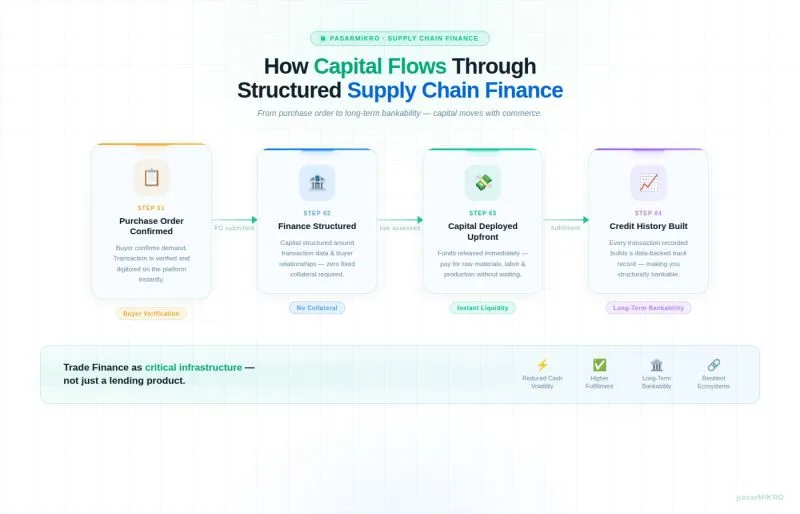
In practice it works in four steps:
- Purchase order confirmed. The buyer confirms demand, and the transaction is verified and digitized on the platform.
- Finance structured. The financing is built around transaction data and buyer relationships, not fixed collateral.
- Capital deployed upfront. The SME can pay for raw materials, labor and production without waiting for the buyer to settle.
- Credit history built. Every recorded transaction adds to a data-backed track record.
A credit history, not just a loan
The last step matters most. By digitizing and recording verified transactions, our system helps SMEs build a solid credit history.
We are not only providing temporary liquidity. We are building the track record SMEs need to become bankable in the long run.
What changes for SMEs and buyers
- Less cash flow volatility
- More reliable fulfillment for buyers
- A clear, data-backed path to long-term bankability
- More resilient supply chains
Infrastructure, not just a lending product
At PasarMIKRO we do not see supply chain finance as just a lending product. We see it as critical infrastructure: the engine for growth within trade ecosystems that can scale, with risk calibrated to real transactions. Our embedded trade credit, Talangin, is built on this idea.
When capital flows with commerce, growth becomes both measurable and sustainable.
The same gap shows up at the other end of a deal, when a supplier has delivered and is still waiting to be paid. We wrote about that in why late payments hurt the smallest business in the supply chain.
If your suppliers have confirmed orders but not the cash to fill them, write to us at hello@pasarmikro.id.
Tags
- Supply chain finance
- SME finance
- Embedded finance
- Working capital